AIEIC · HUMAN-CENTERED AI + COMPUTING EDUCATION
Designing help without handing over the answer
When does an agentic lab help students reason about a system, and when does it only add complexity?
This Cal Poly research effort explored bounded AI assistance, participation signals, academic-integrity safeguards, and instructor visibility around engineering labs. The most useful result was not a universal case for agents. It was a clearer account of where they fit and how the architecture had to change.
Working title: Empowering Experiential Learning through an AI-Driven Agentic Design Framework for Engineering Labs
Ordinary chat can collapse the learning process.
A student can ask a general-purpose model for a finished answer before practicing decomposition, coordination, monitoring, or evaluation. The research treated that tension as a design constraint: assistance should be grounded in approved course context, escalate gradually, leave useful evidence for the instructor, and never turn a probabilistic signal into an automatic academic judgment.
Three phases replaced a sprawling center.
The final report describes a simpler harness after developers and test users found the complex orchestrator harder to integrate and less predictable.
pre-lab
Curriculum generation, environment setup, and instructor-reviewed preparation.
during-lab
Scaffolded help, participation logging, integrity signals, and safety monitoring.
post-lab
Assessment, analytics, reflection, and instructor review.
These are workflow boundaries in the latest report, not proof of three isolated production services.
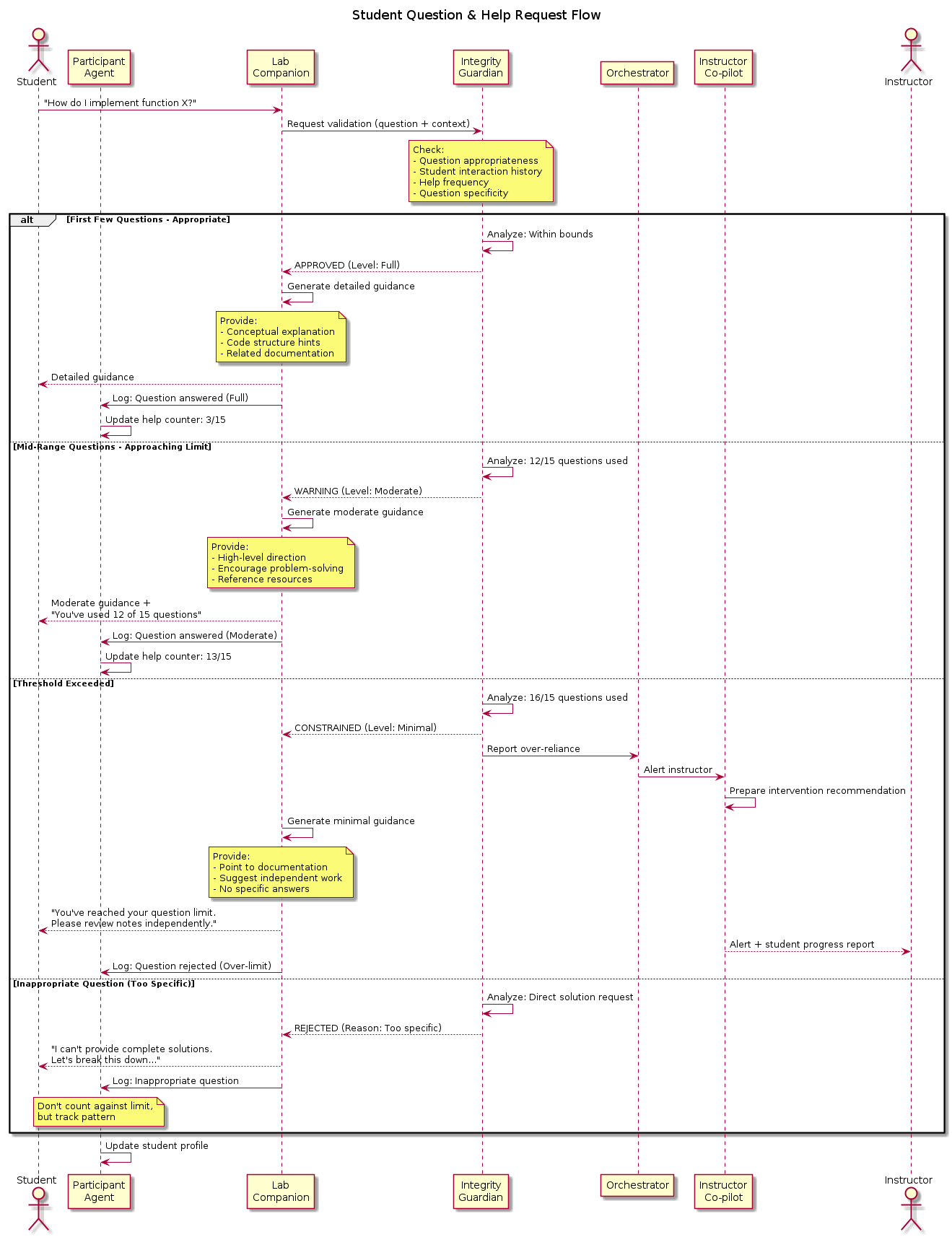
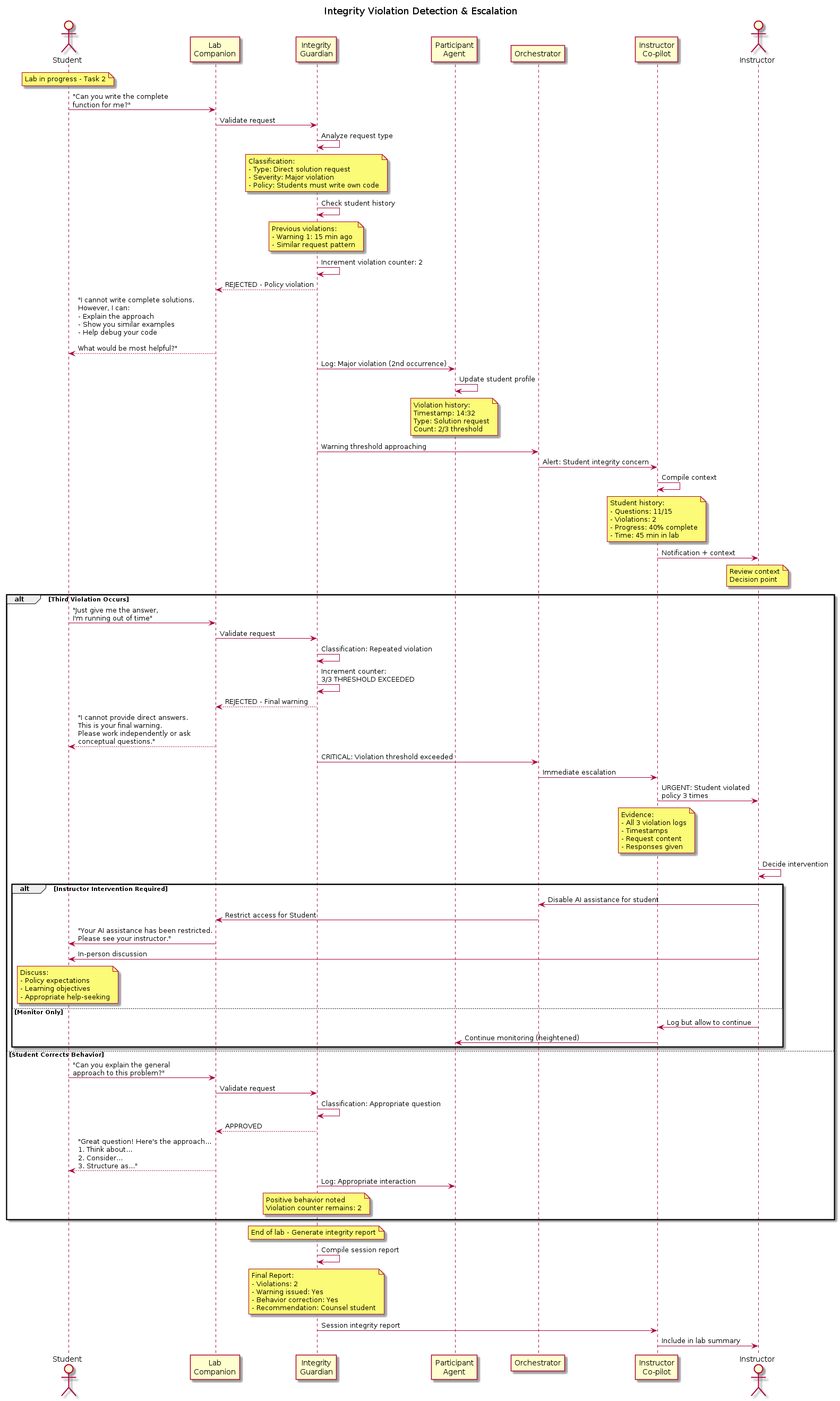
A question leaves a trail of evidence, not a verdict.
The conceptual flow retrieves approved course context, offers progressively stronger hints, logs the interaction, and checks for integrity signals. When the system sees a meaningful pattern, the instructor remains the decision-maker.
- Student questionstarts with the lab context and the learner's request
- Retrieval + progressive hintsgrounds assistance and avoids jumping straight to a solution
- Participation loggingrecords question type, hint level, and session context
- Integrity signalsurfaces patterns for review rather than declaring misconduct
- Instructor oversightkeeps consequential decisions with a person
The design became simpler because integration taught us where the boundaries hurt.
Broad multi-agent framework
An orchestrator and specialized agents made curriculum, tutoring, participation, integrity, assessment, operations, and instructor support explicit.
Distributed services
Teams built component APIs, dashboards, contracts, and service-specific state at different levels of maturity.
contract drift · fragmented state · duplicated policy · hard-to-trace failures
Pre / during / post harness
The same learning workflow was reorganized around three predictable phases instead of a complex autonomous center.
Earlier documents also propose a deterministic orchestrator and a shared Postgres learning record. Those are design recommendations, not verified shipped architecture.
Different components produced different kinds of evidence.
Lab Companion
Retrieved course and lab material before producing scaffolded assistance. The available documents describe the design, but do not establish a final production retrieval implementation.
Participant Agent
A FastAPI service classified question type, hint level, difficulty, and confidence with GPT-4, stored events in Cosmos DB by student, then applied a deterministic heuristic for learner status.
Integrity path
Produced query-count and similarity signals. A safer integration keeps the component observational while workflow policy and instructor review remain elsewhere.
Instructor dashboard
A React 19, TypeScript, and Vite prototype supported cohort views, drill-down navigation, student details, and an AI Overview. Its displayed student records are mock data.
MY VERIFIED CONTRIBUTION
Team leadership, instructor-facing workflows, and Participant Agent contracts.
I served as an overall team lead and contributed to the instructor/research dashboard, including the student-detail modal, AI Overview, typed API client, navigation and drill-down behavior, and CAS login interface. On the Participant Agent, my verified work includes API contracts, health and root endpoints, standardized errors, status and cohort endpoints, the deterministic status heuristic, and a minimal-diff refactor that reduced merge risk.
The supplied evidence does not support claiming that I built every agent, implemented the full orchestrator, or deployed the proposed Azure architecture.
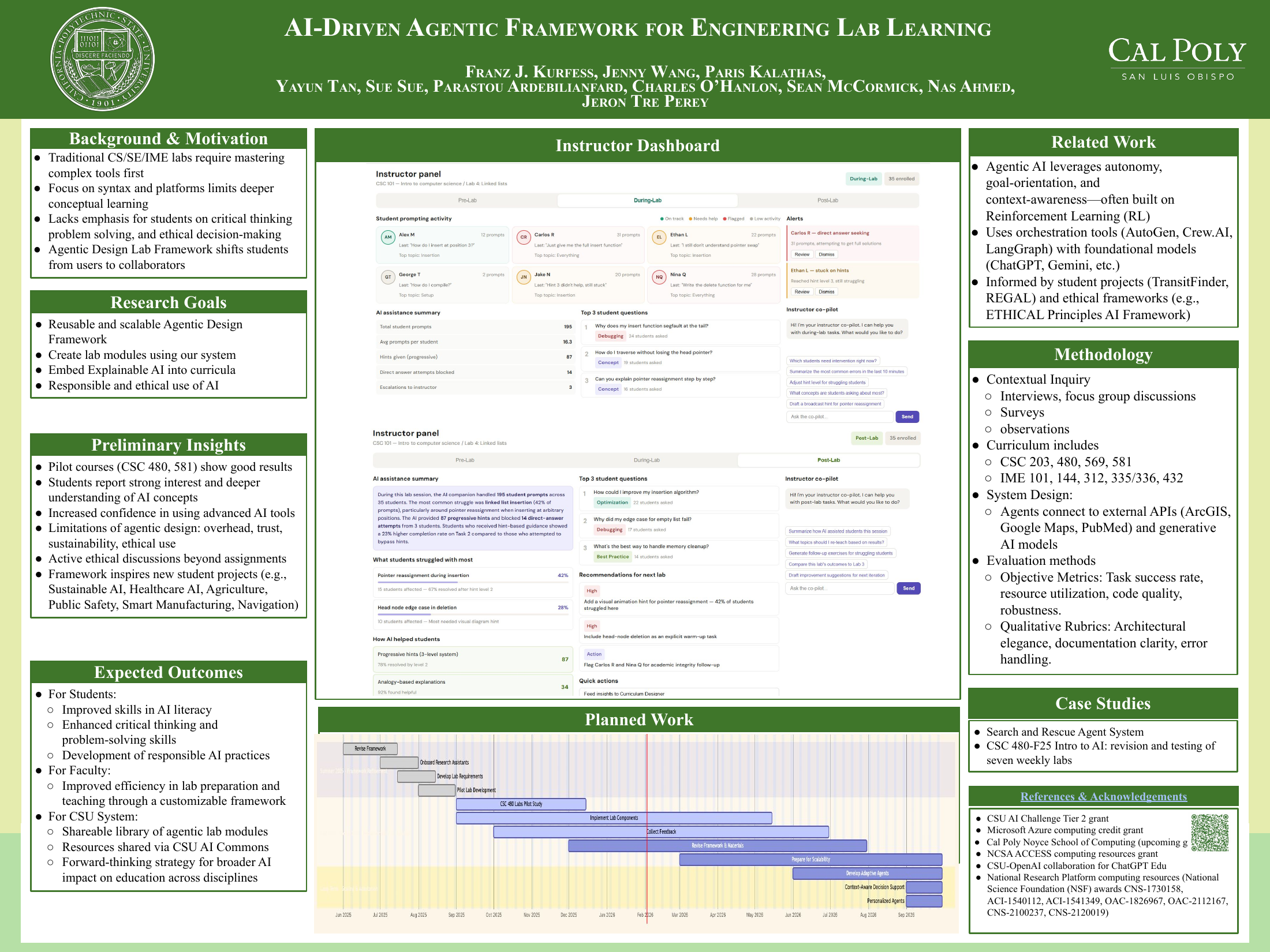
Promising operational signals, with important limits.
The final report describes selected CSC 480 Fall 2025 labs and later curricular work across CSC 480 and CSC 580. These values are useful early observations, not causal evidence that the agentic format improved learning.
Agents were a fit only when the reasoning task had enough structure to warrant them.
The agentic layer added ceremony without creating enough new reasoning value.
Its fit depended on how much complexity lived in the heuristic and problem formulation.
Its roles, iteration, and feedback structure mapped more naturally to an agentic lab.
Architecture should follow the learning task. More agents do not automatically create more learning, observability, or reliability.