EE 428 computer-vision team project · Spring 2026
Deepfake Face Detection
Can a detector trained on one kind of fake face recognize another?
- PyTorch
- EfficientNet-B3
- ResNet-50
- Xception
- OpenCV
- FFT
0.9861 → ≤ 0.62
in-domain AUC to cross-dataset AUC
does a detector learn manipulation, or one generator's fingerprint?
The project compares fully synthetic StyleGAN3 faces with DFD identity-swap video frames. A model can separate real and fake inside either dataset while relying on artifacts that disappear as soon as the generation process changes.
Our four-person team built parallel model branches; my branch is an end-to-end PyTorch/Colab implementation and the source of the pipeline, cross-dataset experiments, and EDA described here. The final report synthesized team results.
in-domain success followed by a deliberate stress test
Two fake families
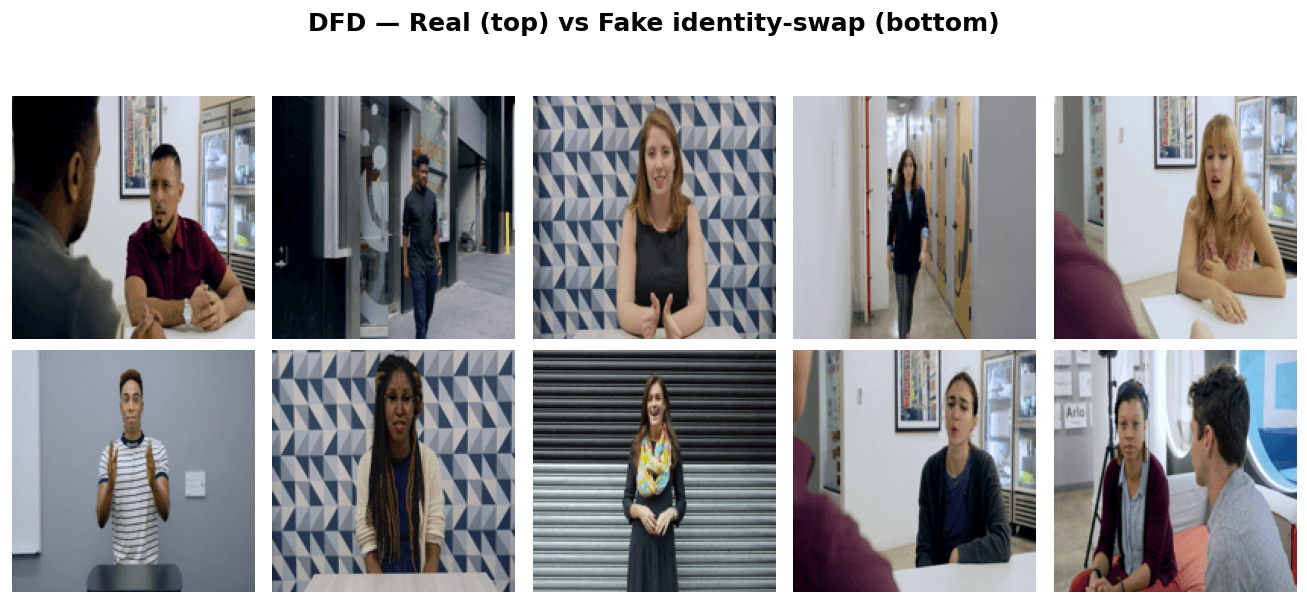
StyleGAN3 creates whole faces from noise; DFD blends identities into real video frames.
Three backbones
EfficientNet-B3, ResNet-50, and Xception run through the same two-stage transfer-learning loop.
Cross-dataset evaluation
Each detector is evaluated on a balanced sample from the other manipulation family.
Frequency investigation
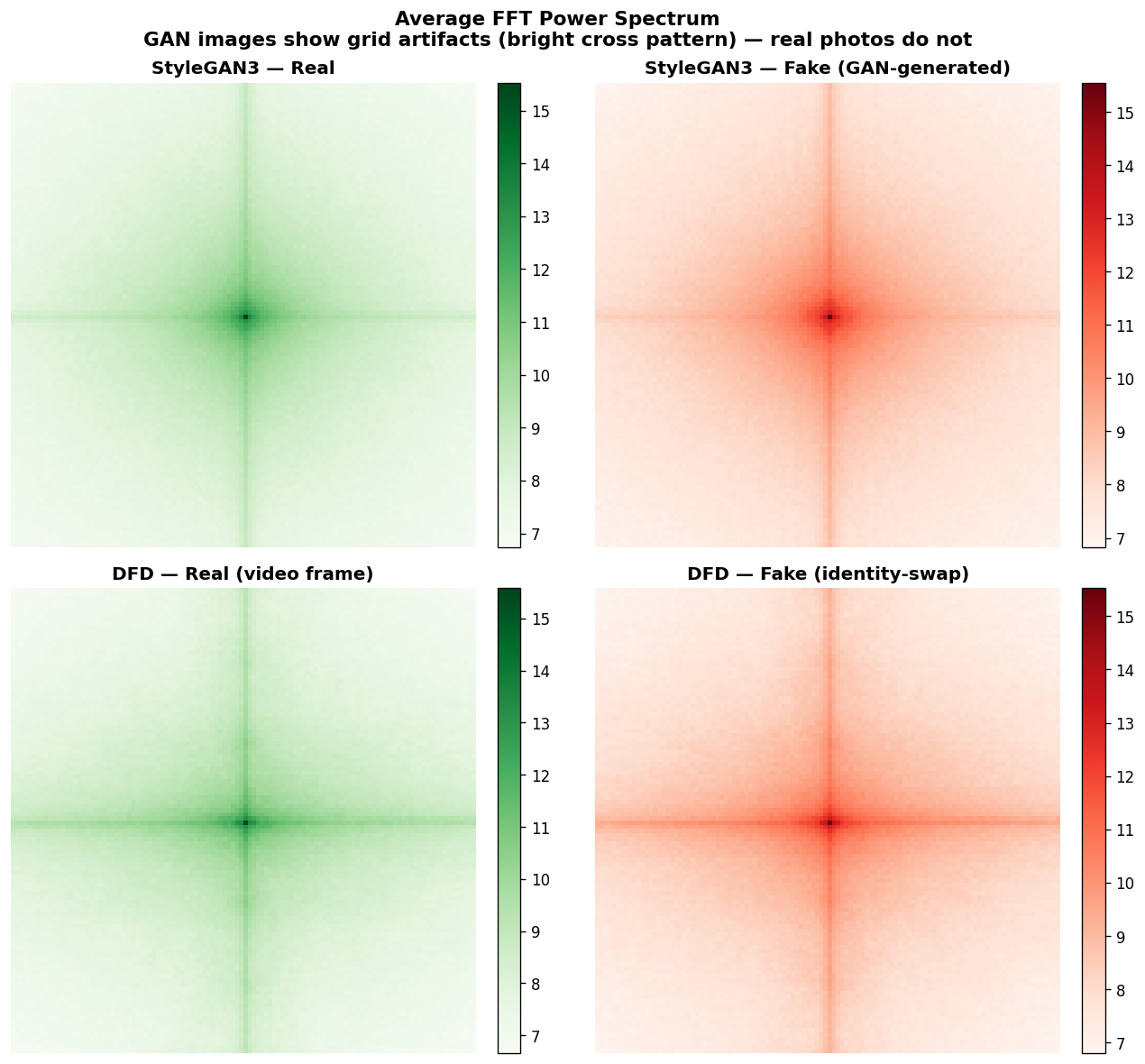
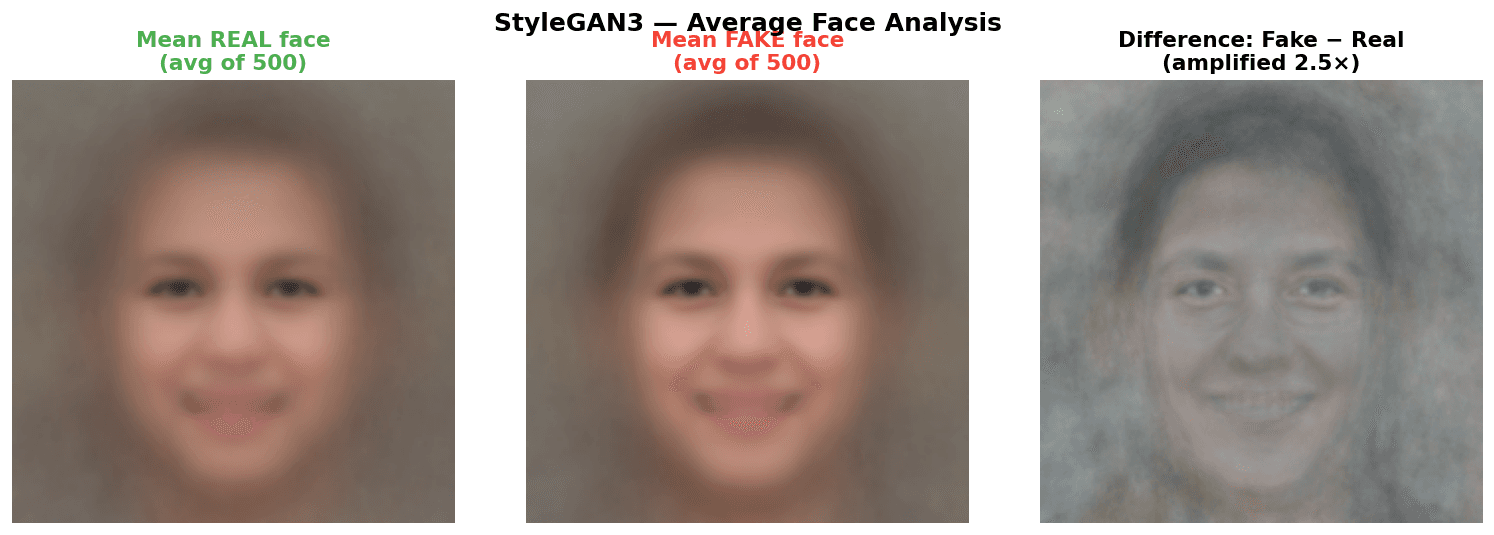
Mean faces, RGB histograms, and 2D FFT spectra probe whether generator-specific artifacts help explain the model failure.
the research infrastructure
PyTorch + timm
Provides custom datasets, the shared classifier head, staged fine-tuning, AMP, and pretrained CNN backbones.
OpenCV
Extracts representative DFD frames with resume logic for interrupted sessions.
scikit-learn
Computes stratified splits and comparable accuracy, F1, AUC, ROC, and confusion outputs.
Colab + Drive
Free GPU compute plus persistent file lists, checkpoints, and JSON histories survive runtime resets.
matplotlib + seaborn
Turn samples, spectra, confidence distributions, and model results into the evidence used in the research story.
Two very different kinds of fake
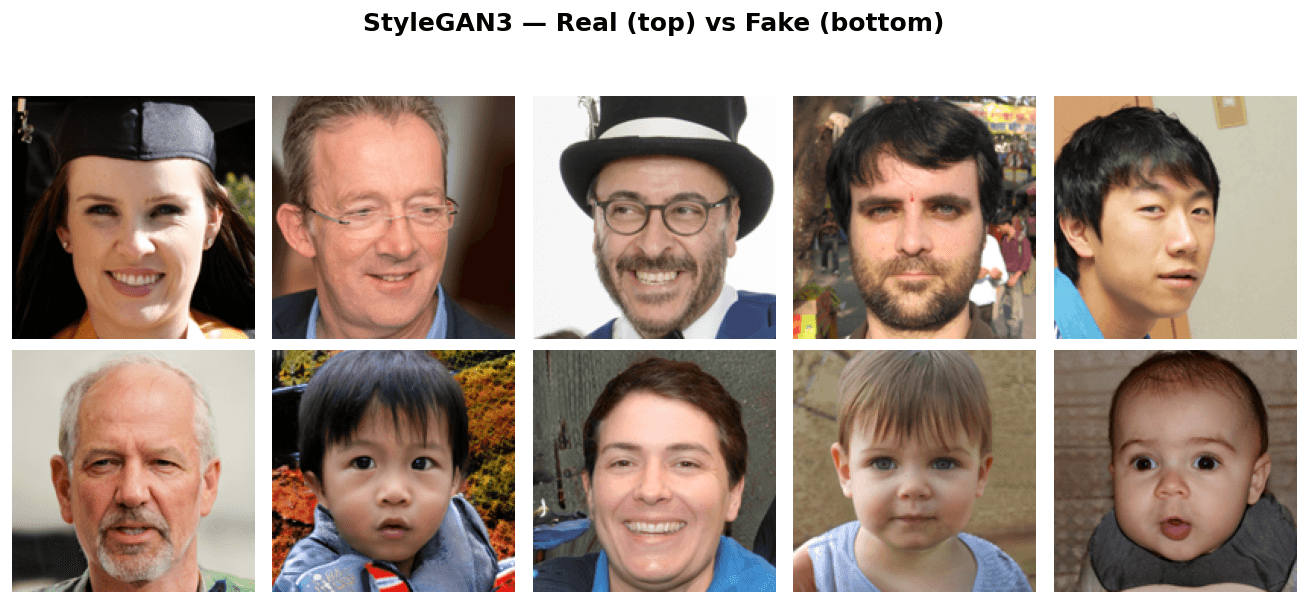
StyleGAN3 synthesizes whole faces; DFD manipulates identities inside real video frames. Their artifacts, class balance, and visual statistics are not interchangeable.
A resilient Colab pipeline
I built a roughly 50-cell pipeline for environment setup, cached data, frame extraction, loaders, staged fine-tuning, checkpoints, and 13 numbered experiments across EfficientNet-B3, ResNet-50, and Xception.
The design could resume after interrupted Colab sessions instead of losing an expensive run.
The flattering number was not the answer
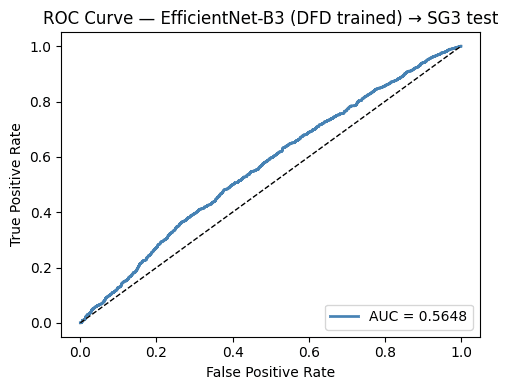
EfficientNet-B3 reached 94.4% accuracy and 0.9861 AUC on StyleGAN3. Across datasets, every AUC stayed below 0.62; one SG3-to-DFD configuration produced F1 = 0.0000 because it called every image real.
The result is consistent with a detector relying on generator-specific cues rather than a general concept of manipulation.
Looking for the fingerprint
I generated paired image grids, averaged faces, RGB histograms, and 2D FFT power spectra. The frequency analysis supports a plausible explanation: StyleGAN upsampling artifacts differ from the signals created by face blending.
the complete vertical slice on my branch
I authored the dataset loaders, model factory, training and evaluation scripts, frame extractor, roughly 50-cell experiment notebook, and separate EDA notebook on my unmerged branch.
- Implemented EfficientNet-B3, ResNet-50, and Xception under one repeatable training interface.
- Engineered around Colab disconnects with file-list caches, local copies, checkpoint guards, and saved histories.
- Designed the bidirectional cross-dataset test instead of stopping at the strong in-domain number.
- Built FFT/mean-face visual analysis to connect the observed failure with a plausible mechanism.
parallel branches, one synthesized report
Each teammate developed an independent pipeline on a separate branch. The written report combined the team's model results, but the codebases were not merged; the page therefore separates the project-wide research question from the implementation on my branch.
a few more pages from the process
results, with context
StyleGAN3 accuracy
Excellent performance on familiar generator artifacts.
in-domain AUC
The model separated classes well inside that dataset.
cross-dataset AUC
Transfer stayed close to chance across every direction.
The failed transfer is the project’s most useful result. I would train across more generators and manipulation families, then evaluate domain generalization before treating any in-domain score as evidence of a robust detector.