CSC 487 deep-learning team project · Winter 2026
Deep Purring
Can you estimate a cat’s age from its meow?
- PyTorch
- librosa
- SmallCNN
- ResNet-18
- SpecAugment
- scikit-learn
74.8%
best held-out-cat accuracy
a cat is the unit, not a clip
Deep Purring asks whether a vocalization contains enough signal to classify a cat as kitten, adult, or senior. The playful question exposed a serious evaluation problem: recordings from the same animal can make a random clip split look much better than real generalization.
The project is a team research prototype. My work covers the YAMNet baselines, the raw-audio spectrogram pipeline, SmallCNN/ResNet-18 comparison, and the cat-level leakage correction used across team notebooks.
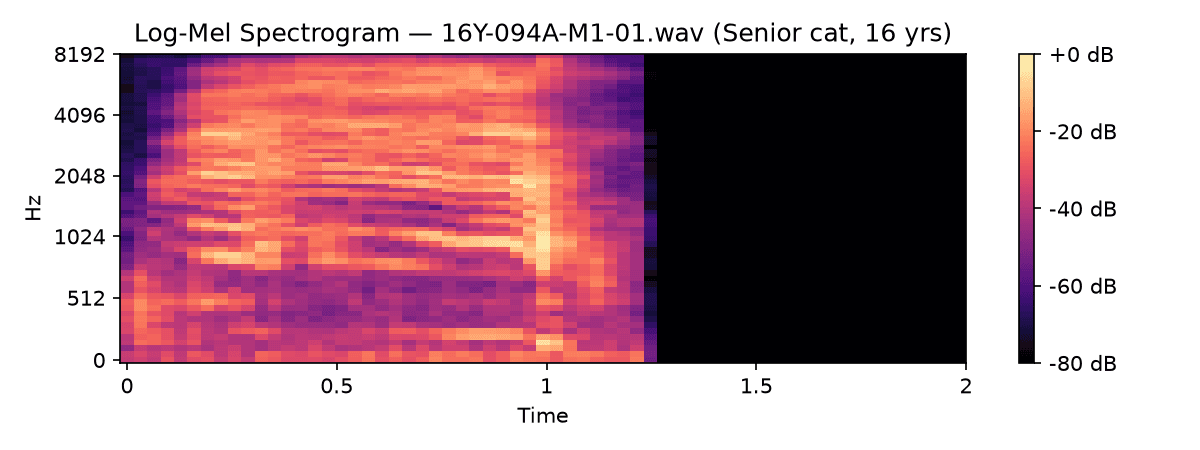
three representations of the same meow
Embedding baselines
YAMNet converts audio into embeddings; PCA, scaling, logistic regression, and SVM establish a non-deep-learning reference.
Raw-audio CNN
A custom dataset converts two-second clips into 64-bin log-mel spectrograms for a compact SmallCNN.
Transfer learning
An ImageNet ResNet-18 is adapted to one-channel spectrograms to test whether a larger visual backbone helps.
Inference demo
The notebook accepts a new WAV file, applies the same preprocessing, and returns age-group probabilities.
the notebook stack in context
librosa
Loads, resamples, windows, and transforms raw waveforms into log-mel features.
PyTorch
Implements the dataset, augmentations, SmallCNN, adapted ResNet-18, training loop, and inference path.
scikit-learn
Provides grouped splitting, PCA/scaling, classical baselines, and confusion-matrix metrics.
Jupyter
Keeps audio inspection, experiments, visualizations, and demo inference together for a course research workflow.
From sound to image
Each clip is resampled to 16 kHz, normalized to two seconds, and converted into a 64-bin log-mel spectrogram. Custom time and frequency masking adds controlled variation during training.
The split was leaking cats
The first clip-level split let different recordings from the same cat appear in both training and test sets. That made the model look better at recognizing age when it could partly recognize individuals.
I replaced it with cat-level GroupShuffleSplit across the team notebooks so every test animal was truly unseen.
A small CNN beat transfer learning
On the seed-42 held-out-cat split, SmallCNN reached 74.8% accuracy and 0.67 macro-F1. ResNet-18 reached 49.6% and 0.38.
Across seeds, SmallCNN averaged 64.4 ± 9.1% accuracy, making the dataset’s instability visible rather than hiding it behind the best run.
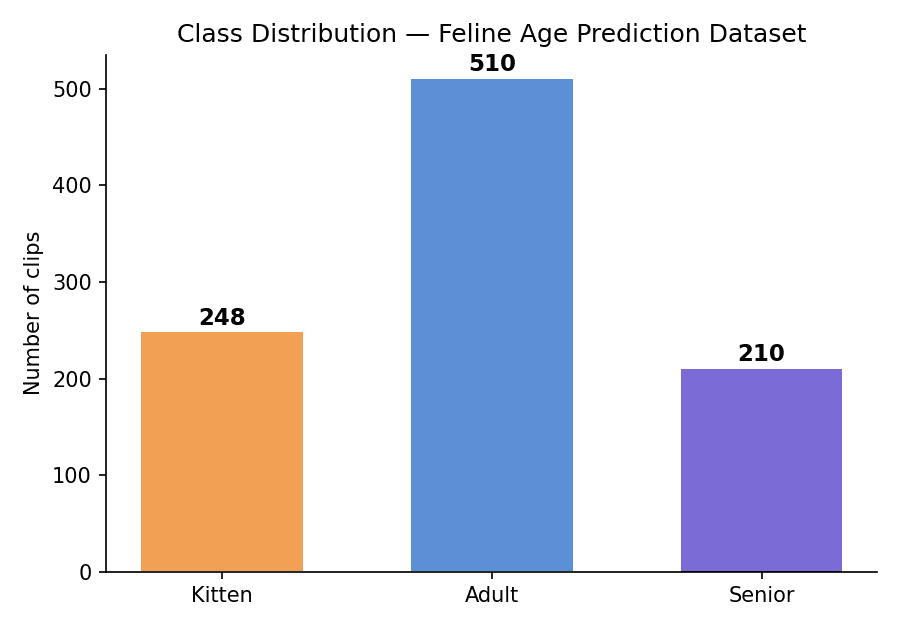
the notebooks and evaluation changes I owned
I solely authored the baseline and spectrogram-CNN notebooks and then propagated the cat-level split correction across the team experiments.
- Built raw WAV → log-mel preprocessing and a custom PyTorch dataset.
- Compared SmallCNN with one-channel ResNet-18 and classical YAMNet baselines.
- Caught same-cat leakage in the initial clip split and changed the unit of evaluation.
- Reported multi-seed mean and variance rather than presenting 74.8% as a stable universal score.
parallel models, shared evaluation discipline
Teammates explored other model notebooks and one teammate connected my SmallCNN to a Flask demo branch. The shared value of my contribution was the reusable audio pipeline and the group-split correction, not ownership of every team model.
a few more pages from the process
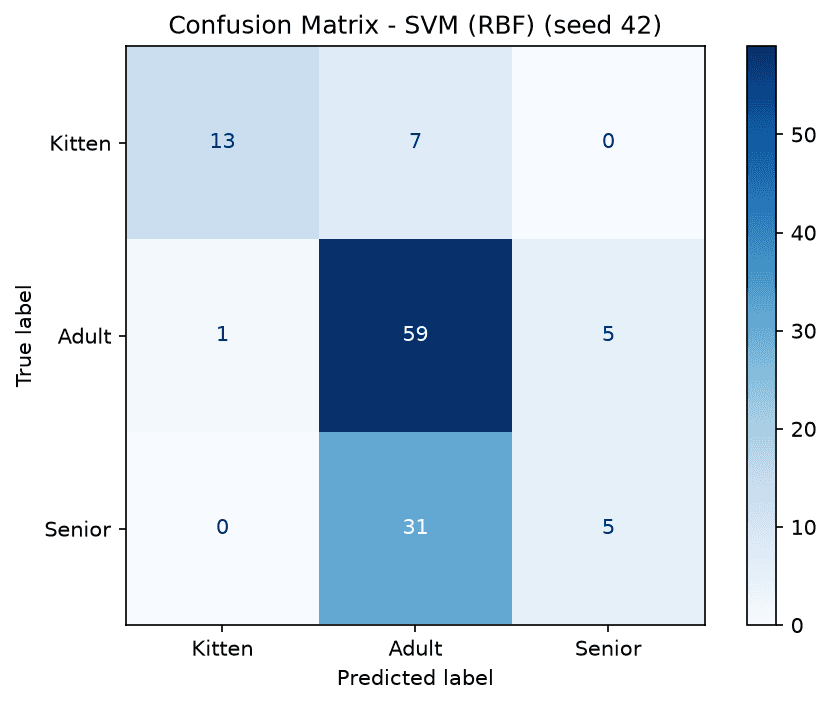
results, with context
best accuracy
The strongest single grouped split, using SmallCNN.
seed-42 macro-F1
Macro-averaged across the three age classes on one grouped test split.
multi-seed accuracy
The variance is part of the result, not a footnote.
The leakage discovery changed what the score meant. A larger cat-level dataset and repeated grouped cross-validation would matter more than adding a larger model. The technical story here stays centered on the notebooks, models, and evaluation changes I can explain most deeply.